Moms Circle Event : All about breastfeeding with Happy Latch!


breastfeeding mom.png

Moms . . .are you pregnant, currently breastfeeding, frustrated with past attempts or just wanting to learn  more in preparation for your next baby?

k

Women’s Health Physical Therapy is hosting a Moms Circle Meetup group that will focus on breastfeeding! We are excited to have Priscilla Moore, owner of Happy Latch, who is an International Board Certified Lactation Consultant (IBCLC), as our speaker!

Priscilla Moore will be incorporating information on healthy foods, healthy sleep routines for new parents and babies, establishing milk supply and also the big topic of nursing in public!

Along with our main theme, we will be discussing a variety of other topics, such as back and pelvic pain and exercise do’s and don’ts during pregnancy and postpartum.

*(We know getting out of the house and finding the right sitter can be a hassle….so feel free to bring your little ones…and your friends too!)


Nurture RVA Birth & Baby Fair 2017

Planning a pregnancy, currently pregnant or in the early stages of parenting?

The Nurture RVA Birth and Baby Fair brings together expecting and new families with the care providers, businesses, and organizations that serve families during this exciting and challenging life transition.

This year’s Nurture Birth & Baby Fair promised an amazing mix of passionate speakers, fun and informational demonstrations and a wide array of resources and vendors to support pregnancy and parenting! They definitely delivered . . . !

IMG_7349

If you were not able to attend this year’s event, here is a little recap for you:

The Science Museum of Virginia partnered with Nurture this year and provided an incredible venue for everyone attending! The setup started around 8AM and by 10AM, people started trickling in with curious and excited faces.

Some of the ventures this year included MyBirth, Candy Bears-Kim who is a pediatric sleep consultant, Happy Latch, Embrace, Massage Therapists, Doulas, Midwives and much more!

Along with local pregnancy, birth and postpartum resources, there were fabulous raffle prizes, massages, and awesome demonstrators, such as NurtureCORE Kids Academy Women’s Health Physical Therapy CarryBean

IMG_7367
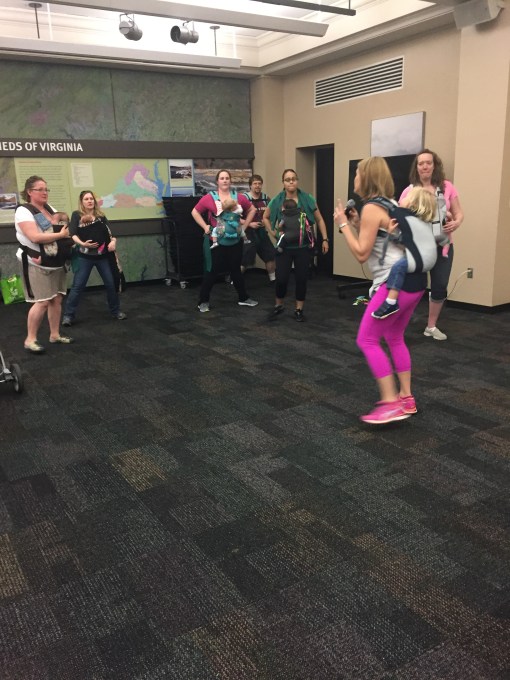
CarryBean’s demonstration

Along with being one of the vendors at this year’s Nurture fair, we had the wonderful opportunity to be one of the demonstrators! Our focus was as follows:

U.S. women who have babies deserve musculoskeletal screening like women in Canada, Australia, and France! Come learn to be POSTPARTUM STRONG® by practicing exercises to prevent a “mummy tummy”, leaking, prolapse, and…sexual dysfunction.

IMG_7353
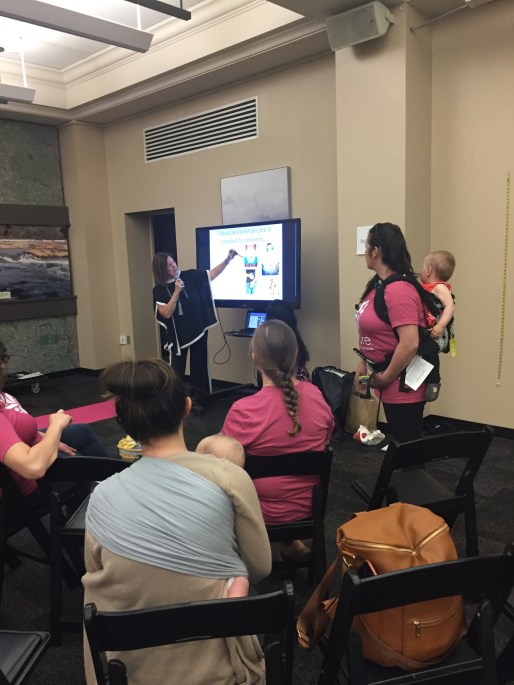
Dr. Cora Huitt giving a brief presentation on pelvic floor education and the options available through specialized physical therapy.
IMG_7365
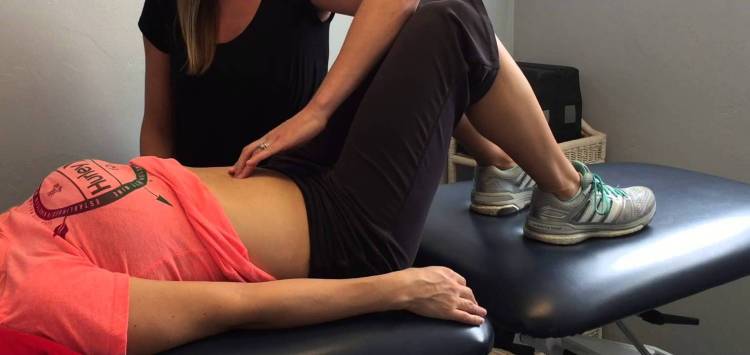
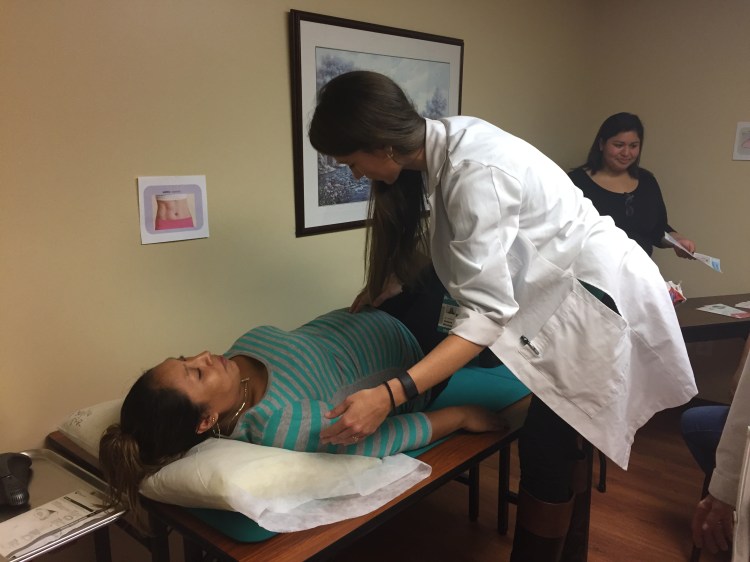
Dr. Casey Smith checking for abdominal muscle separation, also known as a diastasis recti.
IMG_7364
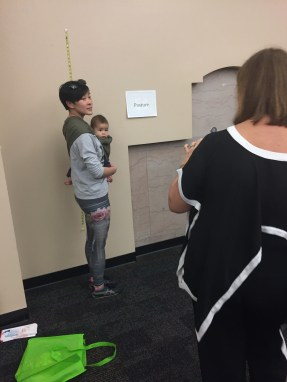
Dr. Cora Huitt taking a posture picture to show that small changes can make a huge difference in how we feel and heal!


Here are Women’s Health Physical Therapy, we love educating our community on the importance of supporting your pelvic floor function, postural alignment, abdominal and deep trunk muscles, coupled with proper breathing. Focusing on the “core 4” helps to prevent incontinence, prolapse, back pain and sexual dysfunction.

IMG_7359
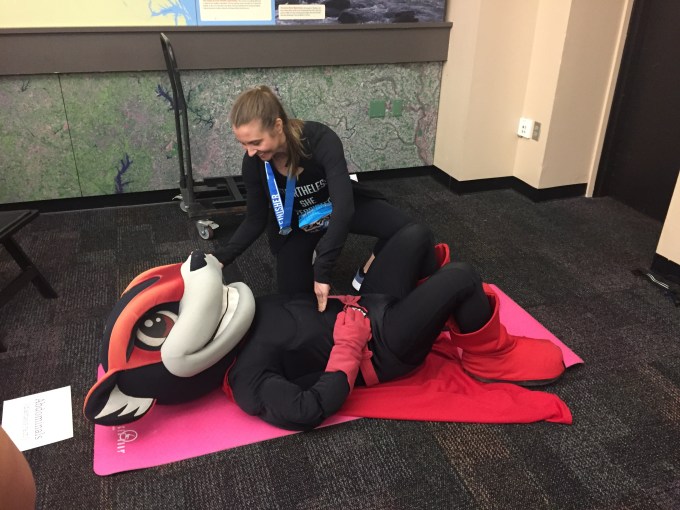
Even Nutzy, The RVA Flying Squirrel’s mascot, got in on the action!


Yes, it’s that time of year again . . . !

It’s time for the ISSWSH Annual Meeting 2017! I always look forward to these conferences and the opportunity afforded for communication among scholars, researchers, and fellow practitioners about women’s sexual function and health.

This year’s annual meeting is in the beautiful city of Atlanta, Georgia!


atlanta-fountain

The theme of this year’s meeting is The Embodied Mind, and we have an intriguing line-up of speakers and topics that will explore the core components of the mind-body relationship as they relate to female sexual expression, physiological milieu, resilience, and change.

ISSWSH is the only society devoted to a multidisciplinary understanding of female sexuality across the lifespan and is led by a passionate group of international academics, clinicians, health professionals, and scientists who have largely shaped the field of female sexual health research.

The attendee line-up include gynecologists, sex therapists, clinical psychologists, patient advocates, physical therapists (YES!!), family physicians, nurse practitioners, basic scientists, clinical researchers, sex educators, and trainees who share this passion for understanding and actively promoting female sexual health.

isswsh-1

isswsh-2

The field of female sexuality is approaching a critical turning point in its evolution. We are positioned to explore, question, and potentially redefine the traditional sexual constructs we have inherited, as these ideas do not capture the broad spectrum of sexuality we encounter in the streets, in the clinic, in the lab, or in our homes. This freedom is both exhilarating and terrifying. We are entering one of the most exciting periods of change in modern sexology. Every step forward is a small revolution.


Photo Credits: Dr. Cora Huitt
Article Sources: http://www.isswshmeeting.org/about/welcome-message


clover-event-jpeg

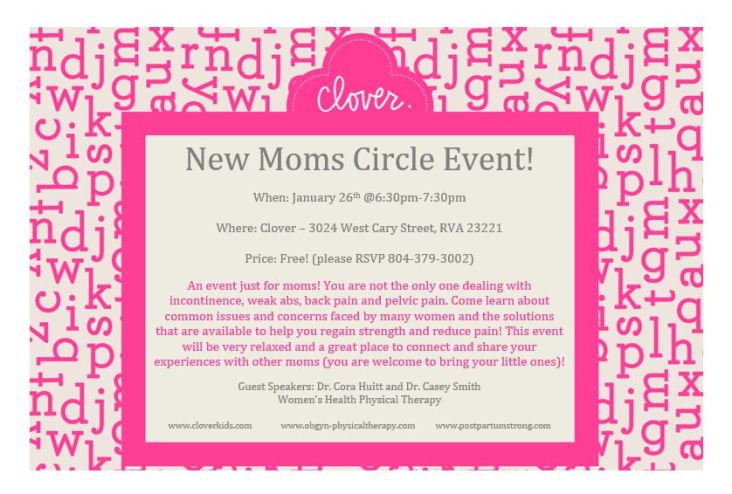
New Moms Circle Event!

When: January 26th @6:30pm-7:30pm

Where: Clover – 3024 West Cary Street, RVA 23221

Price: Free! (please RSVP 804-379-3002)

An event just for moms! You are not the only one dealing with incontinence, weak abs, back pain and pelvic pain. Come learn about common issues and concerns faced by many women and the solutions that are available to help you regain strength and reduce pain! This event will be very relaxed and a great place to connect and share your experiences with other moms (you are welcome to bring your little ones)!

Guest Speakers: Dr. Cora Huitt and Dr. Casey Smith

Women’s Health Physical Therapy


www.cloverkids.com              www.obgyn-physicaltherapy.com          www.postpartumstrong.com

“Why do I still look pregnant?”


Scenario . . . 

A new mom has given birth to a healthy baby boy. She is about 6 weeks post-delivery and has been able to lose her pregnancy weight fairly quickly . . . all except for that stubborn stomach area that seems to just poke out.  She feels like she is several months pregnant and also complains about weakness in her abdominal area and a feeling of pressure. She does a quick search on Google and is quickly overwhelmed by a plethora of conflicting information. Some “experts” suggest getting started on a rigorous gym routine,  while others tell her to just accept her new mummy tummy and accept that weak abdominal muscles and a heavy, bulgy feeling are normal.

After joining a mothering circle, she listens to other moms complaining about weakness in their stomach area, pain and weakness. It is then that one of the moms shares that their abdominal issues may be due to a separation of their ab muscles, (also known as a diastasis recti).

mom

So what is diastasis recti . . . ?

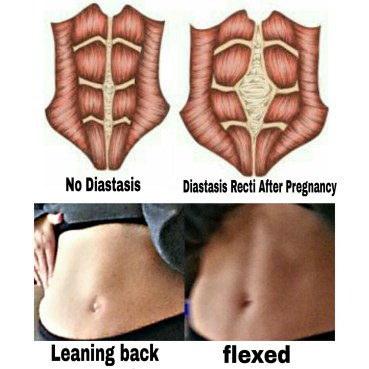
A diastasis recti is a separation of your outer most abdominal muscles. The job of these muscles (called rectus abdominis), is to support your back and your organs.

ab-sep

Did you know . . . ?

Everyone is born with their muscles separated! Usually, the muscles come together when we are three years old after our nervous system has developed. But this does not necessarily happen with everyone.  Because our belly button is a weak spot in the connective tissue, even if the muscles do come together, there is always the risk that they may come apart again.


“So what can I do about it . . .?”

A diastasis can be closed on anyone at any time.  It does not matter when you had your baby or even if you have had a baby at all! Closing a diastasis is all about healing the connective tissue.  Everyone’s connective tissue will heal at a different rate. It depends on the “condition” of your connective tissue.  The weaker your connective tissue the longer it will take.  Also, the connective tissue on people who have stretch marks will take longer to heal.

diastasis-recti-copyright

Healing the connective tissue is all about putting it in a better (narrow) position, bringing blood flow to it and protecting it when doing any type of activities so it is not being stretched nor does it have any intra-abdominal force or pressure on it.

Surgery should be your very last resort! If you decide on surgery, your abdominals must be strengthened beforehand  to maintain the integrity of the sutures.  The surgery to repair this requires a hipbone to hipbone incision.  The recovery from this surgery is very difficult.

Thankfully, there are  research and evidenced based exercise programs, such as the Tupler Technique®, that work with your body to treat diastasis recti and help you regain proper function and strength!


Sources:


STOP! Check that belly before doing those crunches

Did You Know?

36% of postpartum women will discover they have a separation of their stomach muscles. 

If you want to flatten out that post-delivery mummy tummy, you should go straight to the gym for a rigorous regimen of abdominal exercises, right? Wrong!  Diastasis recti could be the cause of that rounded, pregnant-looking and even sore abdominal muscles, months or even years after giving birth.

Before you even think about doing an abdominal exercise, get a belly check to determine whether or not you do have a diastasis recti.

So . . . what is a Diastasis Recti?

A diastasis recti is a separation of your outer most abdominal muscles. The job of these muscles (called rectus abdominis), is to support your back and your organs.

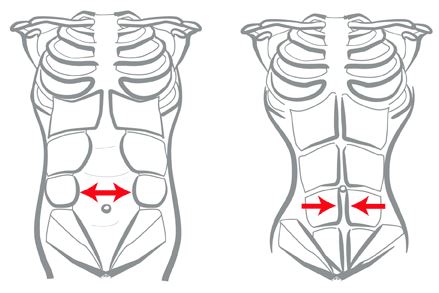
So why should you care if your muscles are separated? Because separated muscles are weak muscles. Separated muscles cannot do their job of supporting your back and organs. To achieve a strong core, your muscles must be close together.

tupler-diastasis

When the muscles separate, the connective tissue (linea alba) joining these muscles stretches sideways.  This sideways stretching of the connective tissue causes it to become thinner and weaker.  So what happens is this weak saran wrap-like connective tissue is now ineffectively supporting your belly button, back and organs, instead of the muscles if they were close together.

Women’s Health Physical Therapy is excited to be offering a specialized Diastasis recti treatment called the Tupler Technique® and is offered through our Postpartum Strong® program.

checking-diastasis

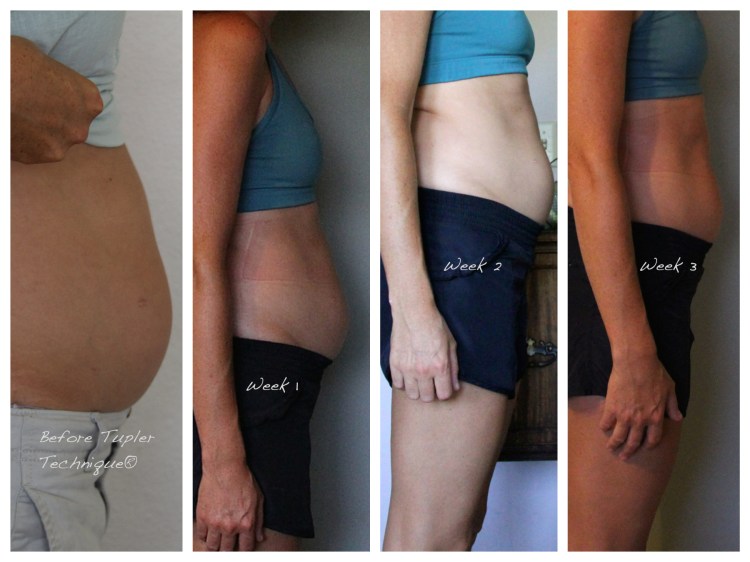
The Tupler Technique® is a research and evidenced based exercise program to treat diastasis recti which is a separation of the abdominal muscles. Casey Smith, PT, DPT, CSCS, an expert in treating diastasis recti, is licensed in this technique and has been working with women to help them close their diastasis and help them achieve their fitness goals. Closing a diastasis with the Tupler Technique® is all about healing connective tissue.

>>>> Check out these amazing before-and-after pictures!

3 reasons the Tupler Technique® helps you heal faster:

  1. Continuously approximating or bringing both the connective tissue and muscles closer together with the Diastasis Rehab Splint®. This takes the stretch off the “stretched out” connective tissue and puts the connective tissue in a better position to heal and do the Tupler Technique® exercises. This also puts the outermost abdominal muscles in a better position to do the exercises. To strengthen abdominal muscles they must be close together and move from front to back. When they are separated they will move sideways which not only does not strengthen the muscles but it stretches the connective tissue.
  2. Protect the connective tissue from getting stretched from activities and movements that stretch it (i.e crunches, forward crossover movements, downward facing abdominals or movements that flare the ribs)
  3. Develop transverse awareness and strength with the Tupler Technique® exercises so the transverse muscle can then be used with activities of daily living and also while working out. The Tupler Technique® exercises for diastasis recti will put tension on the “splinted” connective tissue which will help to make it stronger.

Making a diastasis smaller with the Tupler Technique® is also important before abdominal surgery (ie umbilical hernia) to prevent an incisional hernia and during pregnancy to prevent a c-section.

tupler-progression

To make an appointment to get your belly checked with Dr. Casey Smith, please call our office at 804-379-3002. You may also email us at whptrichmond@gmail.com

“He aprendido mucho!”- Reaching the women at CrossOver Healthcare Ministry

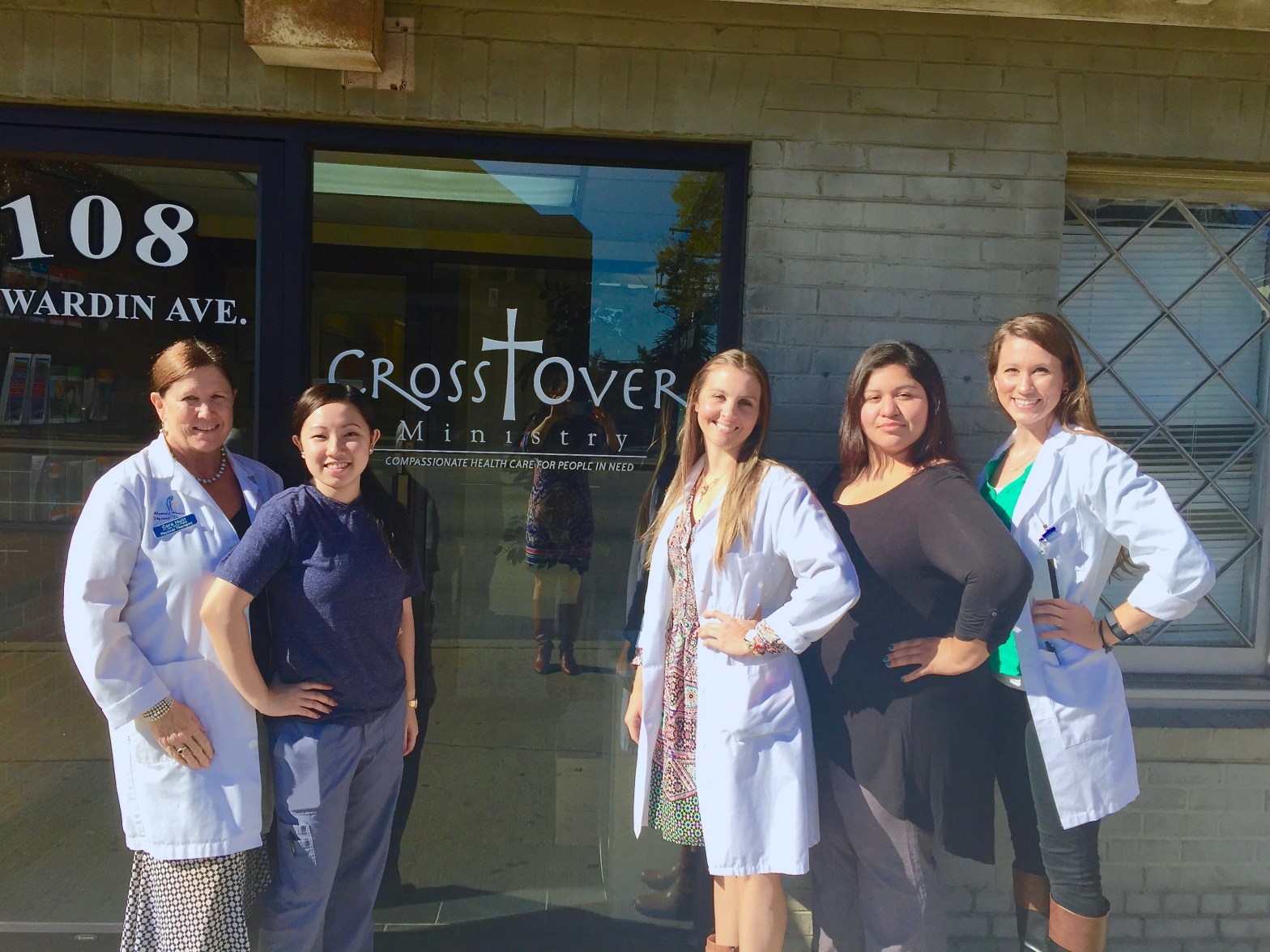
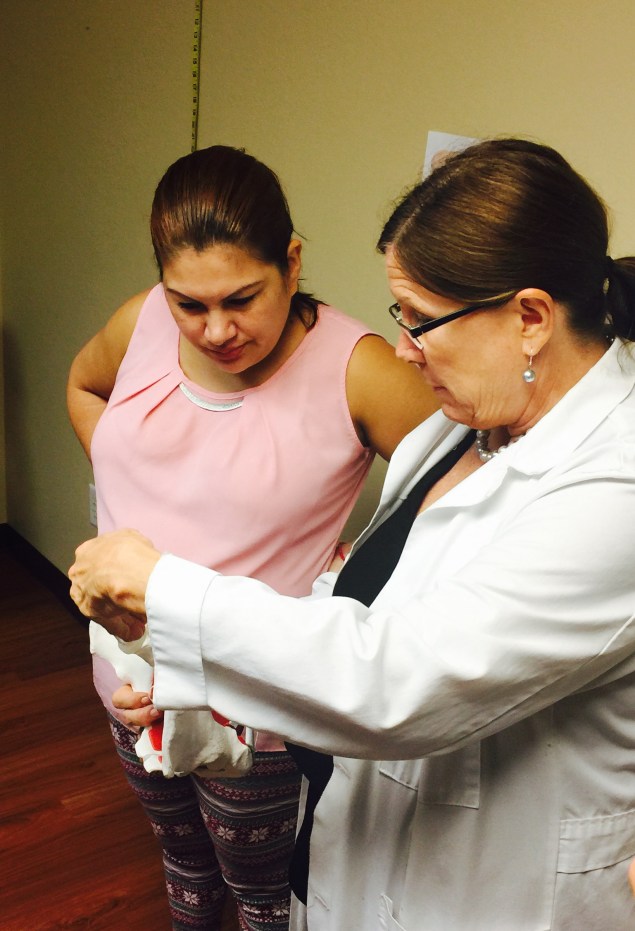
Women’s Health Physical Therapy of Richmond spent the morning at CrossOver Healthcare Ministry screening pregnancy and postpartum patients for common ailments seen during and after pregnancy. CrossOver Healthcare Ministry provides quality and compassionate health care to the uninsured in the greater Richmond Metropolitan area. These screenings spanned from posture analysis and child care body mechanics to pelvic alignment and abdominal muscle separation. The PTs provided the women with tips and tools to decrease pain and risk of further complications.

jas

pink-shirt

While some women came into the screening room excited and somewhat familiar with the PT profession, other women were hesitant and unsure about participating in the screening. One woman in particular expressed that she only wanted to observe the other women having their screenings. However, after only a few minutes, that same woman informed the translator that she was ready to be screened, too.

img_9607

Throughout her one-on-one screening, she received education on ways to protect herself, as well as her baby. By the end of her screen. this woman excitedly explained how she had learned so many new things and felt that she understood her body a little bit better than before. Every women left the screening room that day with a little more knowledge, a little less back pain, and a lot more confidence.

img_9699-jpg

Each of the therapists from WHPT have participated in international health outreach and education projects. They believe that every individual, regardless of language or location should have the tools available to them to protect themselves and provide the best possible care for their infants.

Fit for Fall

Great tips to keep us healthy for the colder weather ahead!

marissaddorsey's avatarWomen's Health & Wellness

Goodbye summer, hello fall!

As we wave goodbye to fresh watermelon, tanning by the poolside and patio brunch dates it’s now time to refocus during the “cozy season”. I hope you reached all of your Summer 2016 goals. If not, roll them right into this fall. It’s never too late to be great!

o-FALL-EXERCISE-facebook.jpg

“Do not be embarrassed by your failures, learn from them and start again.”
– Richard Branson

As we head into October here are a few health-related suggestions to check off:

  • Reassessing your health
  • Fall foods to stock in the pantry
  • Readjusting your sleep patterns
  • How to help prevent the common cold/flu

Know Your Numbers

A proactive way to understanding your body is to schedule a check-up with you PCP. Now that the weather is shifting it is important to have an updated baseline of your blood pressure, cholesterol levels and blood glucose levels. Some individuals may start having a essential…

View original post 528 more words

Healthy Bladder Habits for the Active Woman: Understanding Causes and How to Change

Scenario 1

For sale: Skinny jeans. BNWT.

It’s time for a night out. The skinny jeans are calling. The form flattering fabric is just hanging there in the closet, brand new with tags (BNWT). So why is the black leggings and shirtdress of choice the 10th time?! Because the shirtdress-legging outfit covers for laugh, cough, lift and sneeze leakage. It’s also convenient for pads or panty-liners. tight-jeans

The type of bladder leakage described above is stress urinary incontinence (UI). Stress UI is common among women, but that doesn’t mean it should be considered normal.  Coughing, sneezing, laughing and lifting are just a handful of activities that put pressure on your bladder.  If this describes you, research has shown that training the muscles down there can help!  Training your pelvic floor muscles reeducates them to turn on at the right time, and in turn strengthens too. The best pelvic floor muscle training results come from those who were evaluated and taught by a skilled pelvic physical therapist.  However, that doesn’t mean you can’t try it yourself first! The quick healthy bladder tip I have for you is to try to contract your pelvic floor muscles right before you cough, lift or sneeze. To be sure you are doing it right, try it out now while you are sitting in a chair. Tighten up. This should feel like you are trying to pick up a jellybean with your vagina, or like you are stopping urine midstream. Now cough. You should feel your pelvic floor lift off the chair. If instead you feel it pushing down into the chair, stop and talk to your pelvic floor physical therapist! If you’re holding up just fine with this test, try this exercise out for a couple days. If things get better, keep it up! If things get worse or stay the same, then it might be time to find an expert to get you on the right track and back into skinny jeans – care free!


Scenario 2

Coffee and the Car

Typical workday: wake up, go to the bathroom, get ready, coffee, bathroom again-just-in-case, get to work, more coffee, forget to drink water, pull in the driveway, dig out keys and suddenly the bladder is a balloon ready to burst.

coffee-to-go

With nearly two cups of coffee per day as average consumption for over half of American adults, it’s no surprise that bladder urgency is one of the most common types of urinary incontinence. Urgency urinary incontinence AKA overactive bladder (OAB) can be defined as any unwanted leakage occurring with a sense of urgency. A “ready to burst” bladder may also be followed by a void smaller than the bladder’s capacity. The scenario above brings to light four common catalysts for this feeling of urgency. Firstly, coffee is diuretic and it’s acidic. That means it’s bladder-irritating: it will dehydrate and concentrate urine. Concentrated urine agitates the bladder wall, contributing to a sense of urgency. Secondly, going “just-in-case” fosters a cycle of faulty communication between the bladder and the brain. The bladder begins to tell the brain “I need to go now, even though I’m only ½ full.” Thirdly, drinking less water will actually concentrate urine, which in turn causes bladder irritation, urgency and ironically more frequent trips to the restroom for smaller voids.

overactive-bladder

Finally, the urge and leakage that comes when taking keys out of bag stems from a conditioned body-brain pattern, similar to the automatic salivation that occurs when walking by a bakery. Clearly there are a lot of factors working against your bladder, but there are some solutions. The first and third catalyst can be remedied by drinking less coffee and more water throughout the day. The second and fourth require some reconditioning to establish a better relationship between you bladder and brain. Techniques to recondition or retrain the bladder- brain connection can range from a bladder diary, to quick contractions of the pelvic floor muscles, to mental imagery. These modifications all have the ultimate goal of reducing urge of less-purposeful urination and lengthening the amount of time between bathroom visits.


Scenario 3

The RUN turned WOG + Urge

running-_-feetThere are many reasons why people don’t exercise. Some of these are legitimate health concerns, but for the majority of people this is not the case.  Many female runners struggle with continence, limiting their workout. Their runs starts off with flowing endorphins but then are stilted by their bladder pounding with each stride. To manage the bladder, the run turns into a walk with intermittent jogging. This pounding may signal to the brain that the bladder is actually full.

Like scenario one, leaking while running is a form of stress urinary incontinence (UI). Similar to scenario two, the body-brain connection is distorted and causes a feeling of urgency and fullness when the bladder is only half full!  When urge UI and stress UI are combined, it is called ‘mixed urinary incontinence’. Reducing urge will require techniques, mentioned above, however, reducing the stress for running will likely require endurance and strength training for the pelvic floor. Just like other muscles need to be conditioned to work harder or for extended amounts of time, the muscles in the pelvic floor need to be trained the same way!  A pelvic health physical therapist will prescribe pelvic floor muscle training according to how your body moves, length and intensity of exercise, and other case-by-case factors.
Pelvic-Pain


lynnea-small-bio